
Heat, Boost & the Missing Oil Cooler:
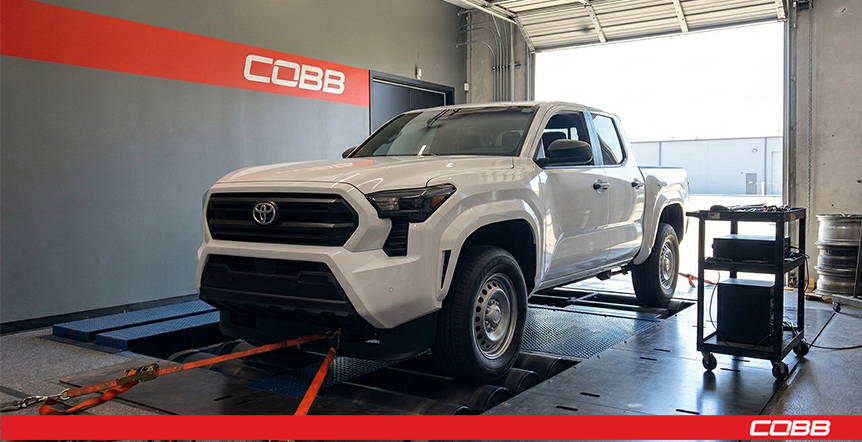
2024–2026 Toyota Tacoma SR on the Dyno
The 2024–2026 Toyota Tacoma’s 2.4L turbocharged four-cylinder is one of the most capable engines to come out of Toyota in years — but not all Tacomas are created equal. The base SR trim is missing something the higher trims take for granted: a factory oil cooler. This test quantifies exactly what that omission costs you, and what a Cobb Accessport Stage 1 93-octane tune does to the equation.
The SR’s Factory Disadvantage
Toyota equips the SR MT, SR5, TRD Sport, TRD Off-Road, Limited, and TRD Pro trims with a water-to-oil heat exchanger — a compact unit that uses engine coolant to regulate oil temperature. The SR AT, as the entry-level trim, ships without it.

Under normal street driving this gap is largely academic. Under sustained performance use — towing on grades, repeated dyno pulls, etc. — the absence of thermal regulation becomes a measurable liability.
The Accessport and Stage 1 tune
The COBB Accessport is an industry-standard ECU calibration device that connects via OBD-II and enables flash tuning without permanent hardware modifications. For the 2024–2026 Tacoma, we offer a Stage 1 93-octane calibration that recalibrates fueling, boost targets, ignition timing, and transmission control module parameters to extract meaningful gains from the stock hardware.
The Stage 1 93 tune used in this test targets approximately 19–21 psi of boost — nearly double the stock calibration’s 9–10 psi. No hardware modifications were made beyond the tune and (in the final test phase) the installation of the factory oil cooler.
Test methodology
All testing was conducted on a chassis dynamometer with the vehicle held in a fixed gear under wide-open throttle from approximately 1,800 RPM through redline. Three back-to-back runs were completed for each condition with no cool-down period between pulls. A fourth run was added for the oil-cooler-equipped condition. Cobb Accessport datalogs captured oil temperature, boost pressure, coolant temperature, ignition timing, knock activity, and dozens of additional channels at approximately 70 Hz.
Three test conditions were evaluated:

Condition 1: Stock tune, no oil cooler
The truck started cold-ish at 174°F oil temperature and completed three pulls in just under six minutes of test time. The pattern is unambiguous: each pull adds heat, and the engine never recovers between runs.

The stock tune pulls are relatively short and peak boost is contained at roughly 9.5–10.6 psi. Despite the modest power output, oil temperature climbed 25°F across the three-run sequence. Run 2 already starts 10°F hotter than Run 1 started — by Run 3, the oil entering the pull is at 194.5°F before the engine is even under load.
Observation: The between-run temperature jump (185°F start of Run 2 vs. 179.8°F end of Run 1) indicates the oil continues to absorb heat even during the idle periods between pulls, as heat soaks from the block into the oil sump with no active cooling mechanism to shed it.
Condition 2: Stage 1 93 tune, no oil cooler
With the Stage 1 93-octane calibration loaded, boost pressure nearly doubles compared to stock. The oil temperature trajectory tells a stark story.

Interestingly, the per-pull temperature delta is slightly smaller under the Stage 1 tune despite generating significantly more power and heat. Regardless, the soak pattern remains severe: Run 3 starts at 193.6°F — nearly 20°F hotter than where Run 1 began.
Key finding: Without an oil cooler, a performance-tuned Tacoma SR accumulates approximately 21–25°F of oil temperature rise across three consecutive dyno pulls. The tuned engine runs the same oil at progressively higher temperatures with each back-to-back run.
Condition 3: Stage 1 93 tune, factory oil cooler installed
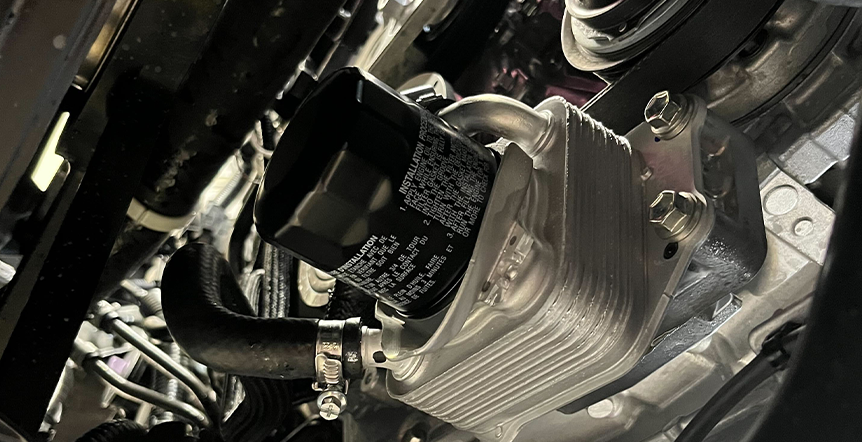
The factory oil cooler — a water-to-oil heat exchanger that circulates engine coolant through a compact core — was sourced from a higher Tacoma trim and installed on the SR. The transformation in oil temperature behavior is dramatic.

The per-pull deltas collapse. Run 2 adds only 0.6°F. Run 4 adds a statistically negligible 0.1°F. The oil cooler is actively working — exchanging heat from the oil into the coolant system, which in turn rejects it through the radiator. The engine is approaching a thermal steady state rather than accumulating heat unboundedly.
The net rise across four pulls (14.8°F) is actually less than the three-pull rise without the cooler (21–25°F), despite one additional run and approximately 25% more power being produced per pull from the tune. The oil cooler is doing more work than the raw numbers suggest — it’s actively shedding heat that would otherwise accumulate.
The direct comparison
Placing all three test conditions side by side makes the impact of each variable impossible to ignore.


What this means in practice
Oil temperature is not just an abstract number on a gauge. Engine oil performs several critical functions that degrade as temperature rises beyond its optimal operating range:
Viscosity and film strength
As oil temperature climbs, viscosity drops. Thinner oil provides reduced hydrodynamic film thickness at bearing surfaces — the very film that prevents metal-to-metal contact. Most full synthetic oils are formulated to maintain adequate viscosity through approximately 220–230°F, but margin erodes as temperatures approach that ceiling.
Oxidation and additive depletion
Every degree above 200°F roughly doubles the rate of oxidative degradation in motor oil. Anti-wear additives, detergents, and viscosity index improvers break down faster under sustained heat. For a performance-tuned engine running harder and longer than the factory intended, this accelerated wear has real consequences for oil change intervals and long-term bearing health.
Bottom line for SR owners: The factory oil cooler is not a luxury item on the Tacoma. It is a thermal management component that higher-trim owners receive automatically. If you own an SR and drive it hard — towing, frequent canyon runs, track use, or performance tuning — retrofitting the factory unit is one of the highest-value reliability modifications you can make before flashing any tune.
Summary of findings
Across three test conditions and ten total dyno pulls, the data consistently supports the following conclusions:
The stock SR without an oil cooler accumulates +25°F of oil temperature across three consecutive pulls on the stock tune.
A Stage 1 93-octane tune nearly doubles boost pressure (9–10 psi → 19–21 psi) but without an oil cooler, heat soak remains similar to stock per pull while the absolute temperatures reached remain severe.
The factory oil cooler, retrofitted from a higher trim, reduces the per-pull temperature rise from 2.6–5.6°F to as low as 0.1°F — a near-complete suppression of heat accumulation.
The net temperature rise across four high-boost pulls with the cooler (14.8°F) is less than three stock pulls without it (25°F), despite more power.
For SR owners considering a performance tune: install the factory oil cooler first. The tune’s gains are real, but so is the thermal stress it adds to an already unregulated lubrication system.
Parts List
If this has convinced you to add an oil cooler setup to your Tacoma SR, below is the shopping list you’ll need. We sourced these all directly from our local Toyota dealership.
| Part Number | Description | Quantity |
|---|---|---|
| 15710-F0030 | COOLER ASSY, OIL | 1 |
| 15197-25020 | GASKET, OIL PUMP | 1 |
| 90119-A0127 | BOLT, W/WASHER | 1 |
| 90915-YZZN1 | FILTER, OIL | 1 |
| 16261-F0130 | HOSE, WATER BY-PA | 1 |
| 165E1-F0010 | CLAMP, WATER BY-PA | 1 |
| 16283-25170 | HOSE, WATER BY-PA | 1 |
| 16268-F0100 | PIPE, WATER BY-PA | 1 |
| 16347-F0020 | GASKET, WATER BY- | 1 |
| 16288-F0010 | PIPE, WATER BY-PA | 1 |
| 16347-F0030 | GASKET, WATER BY- | 1 |